This record traces the history of the St. Louis Water Works from its
beginning up to 1968. It emphasizes the lives and identities of the
men who designed, operated and managed the plants, rather than the
material aspects of construction, pumps and pipes. Each
new generation either forgets or dismisses the contributions made by the
preceding generations in almost any field that you can name. Only the giants
stand out, and sometimes even they are forgotten.
When an enterprise has a history of 139 years, it is not surprising that
some of the most able and respected men who planned these works and operated
them in behalf of the public, are remembered imperfectly, if at all.
It is the purpose of this history to breathe life into their image and
to record their accomplishments.
--W. B. S.
From the time of its founding in 1764 until 1831, St. Louis depended
upon springs and cisterns for its water supply. There is also conjecture
that river water, dispensed by water haulers, was also used to supplement
shortages during dry periods.
As the population of St. Louis approached 6,000 people by 1830, the necessity
for a dependable water supply was imperative.
In 1829 the City entered into a contract with John G. Wilson and Abram
Fox to "Build and conduct water works supplying clarified water."
What the standards for "clarified water" were are unknown at this
late date.
Other conditions of the contract were:
To supply water, free of charge for 12 hydrants, Hospital of Sisters
of Charity and a fountain on grounds of General William
Ashley.
The Works was to belong to the City at the end of 25 years.
Rates - $20 per year for a private family, $100 per year for hotels
and factories.
The City further conceded a bonus of $3,000 cash on the completion of
the works. The location of the river intake was at the foot of Smith Street,
which was located roughly where the Ashley St. generating station of Union
Electric now stands.
General Ashley, who organized and headed the Rocky Mountain Fur Company
must have had a hand in drawing up the contract, because in addition to
the clause in his behalf for free water for his fountain, he sold the City
a lot of ground 170 x 160 feet located on the "little mound" at
the corner of Ashley & Collins Streets for a reservoir site. The water
was to be distributed in cast iron pipes buried not less that 3-1/2 feet
underground.
Little progress was made under the contract, because the contractors
were forced by lack of capital to suspend work, and despite the fact that
the Mayor, Daniel P. Page, gave his private note to secure payment for the
water pipe, the City entered into a new contract with Mr. Fox, Mr. Wilson
having previously sold his interest to Fox.
In the new contract, Fox was released from all the conditions of the
first contract, except the fountain of General Ashley, who probably had
a hand in drafting it also.
The City borrowed $25,000 in 1831 in order to proceed with the work.
In 1835 the City had more equity in the project than Fox, who sold his interest
to the City for $18,000. The City then became sole owner of the water works,
and entered into the
trials and tribulations of public service.
The history of any enterprise, public or private, political or economic,
is the history of men. In waterworks, it is the zeal and foresight of the
many devoted public servants whose names are forgotten by all but a few,
who have assembled and recorded the technique of water supply, without which
no modern plant could function. The St. Louis Water Works has been extremely
fortunate in its 133 years of municipal ownership, to have been served by
so many able men. The names of some of these men and their contributions
will appear throughout this short history.
During the years from 1835 to the close of the Civil War, the system
operated one jump ahead of water famine. This was partly due to insufficient
financing and planning for future development and partly due to the silting
of the reservoirs and the high head losses of small pipe in the distribution
system.
Water was pumped directly into the storage reservoirs without pre-settling.
Various schemes to make the reservoirs easier to clean ended, for the most
part, in failure. There is an instance where a new reservoir was built on
top of an existing reservoir in order to increase the available head. After
a few years, the lower reservoir was abandoned and the upper one used until
1852, when another new one was placed in service.
In 1846 the Superintendent of the Waterworks, probably discouraged by
the difficulty of maintaining an adequate reserve in the reservoirs, suggested
that the supply of water for the City be drawn from the Meramec River. The
discussion on this question
continued until 1854, when the then Superintendent reported against the
scheme.
Still the average citizen was apparently satisfied with the water when
he could get it. An account of how St. Louisans felt in 1858 about their
water supply is graphically described by Taylor and Crooks in "A Sketch
Book of St. Louis" in which they say: "St. Louis is supplied with water from the Mississippi River.
A steam engine of considerable power draws it from the river and forces
it to the reservoir. The water is taken out in the upper part of the City,
above the entrance of any sewers, at a place
where the river is deepest and the current is swiftest, and therefore the
water taken out is the purest that can be obtained.
"The Missouri river imparts its peculiar muddy cast to the Mississippi
at and below their junction, and although the appearance of the water is
not clear, and to a stranger is rather disagreeable, yet it is nevertheless
about the best river water in the world. It is said to keep longer, and
to be sweeter on a sea voyage than the water of perhaps any other stream;
indeed it may almost be said never to spoil.
"The appearance of the water when first taken from the river, or
when the supply from the reservoir has not had time to settle, is rather
muddy and thick, from a great mixture of light sandy particles, and strangers
generally dislike it; but it soon settles on becoming stationary, and then
is very palatable, and persons soon become fond of it--preferring it to
any other water.
"It does not, however, agree with all who use it; until they become
habituated. Some of those, especially Europeans, who after a long confinement
on shipboard, and scant supply of water, find themselves in the midst of
such a river, with power to drink just as much as they please, are apt to
be rather seriously affected by its use.
"But soon these difficulties are overcome; the system becomes habituated
to its use, the muddy appearance is rapidly forgotten, and the sweet, pleasant
taste renders almost any well or spring water insipid in the comparison,
and we long for the supply furnished by the "Father of Waters"!
Even the stranger loves its use; how much more, then, those who for years
have used no other! Supplied from such a source, there can be no apprehension
of failure, although it is not to be disguised that people are often put
on SHORT ALLOWANCE."
We wonder why the Chamber of Commerce of that day did not delete the
last sentence from this glowing recital!
From the start of operations of the waterworks in 1831 until the early
1860's, St. Louis had built 3 reservoirs at various locations and made numerous
changes in piping and pumping equipment, none of which improved reliability
of the supply. It became obvious to the citizens that an entirely new engineering
approach would be necessary to insure a plentiful supply of water.
By 1860 the population of the City stood at 160,773. The idea for a new
water works dates from 1863, when the legislature of the State passed an
act entitled "An Act to enable the City of St. Louis to extend the
Water Works thereof and for other purposes". This Act authorized the
City to build facilities to take water from any point on the Mississippi
and conduct it to the City. It also created a Board of Water Commissioners
to be elected by the Common Council of the City, to carry out the purposes
of the Act. It further provided for the issuance of bonds limited to the
amount of $3,000,000 to pay for the construction.
In conformity with the Act, the City Council passed an ordinance for
regulating the Board of Water Commissioners, but none was appointed. Because
of this lapse of responsibility, the legislature in 1865 amended the Act
of 1863, by placing the appointment of the Board in the hands of the Governor,
which he promptly did.
This Board organized in March of 1865 and on March 27 appointed James
P. Kirkwood as Chief Engineer. In May 1865 the Board directed Mr. Kirkwood
to proceed with the surveys and plans for a system of water works. The plan
was submitted in August of 1865 and forwarded to the City Council for action.
This scheme contemplated the location of the Low Service pumps at the
Chain of Rocks; the works to consist of a pumping station, settling basins,
and filter beds. The filtered water to be conducted by gravity in a conduit
to Baden, where a High service station was to pump it to a reservoir at
Rinkels with a high water line of 204 feet above datum and also to an auxiliary
reservoir on Compton Hill to furnish water to the southern part of the City.
The whole plant was to be designed for 40 mgd.
This plan was rejected by the Council in May of 1866, which recommended
that the filter beds be discarded and the plant located at Bissells Point.
During the consideration of this report by the Council, Mr. Kirkwood
was sent to Europe to examine and report on the methods there in use for
filtering water.
In 1866 the first Board resigned and the second Board directed Mr. Kirkwood
to prepare a design according to the following resolution:
That the Engineer be directed to prepare a general plan founded on the
following basis, to wit:
That the water be taken from the Mississippi in the neighborhood of Bissells
Point.
That settling basins be established there without the accompaniment of
filtering works.
That the storage reservoir be constructed on the City Commons (this was
Compton Hill).
The plan submitted by Mr. Kirkwood was substantially that called for
in the resolution, and was the one by which the Bissells Point Water Works
was eventually built.
The City of St. Louis was extremely fortunate at this juncture of its
history to have in its employ such a capable engineer as James P. Kirkwood.
He arrived in St. Louis in April 1850 as Chief Engineer for the newly organized
Pacific Railroad, and was in charge of the construction of the first section
of that road which was built to Pacific, Missouri. The town of Kirkwood
is named in his honor.
Before his arrival in St. Louis, he was engineer for the New York and
Erie Railroad and had already achieved eminence for completing the STARRUCA
VIADUCT at Lanesboro, Pennsylvania. This was the most expensive railroad
structure of its day, built of masonry 100 feet high with arches of 50 feet.
span and a total length of 900 feet.
James Pugh Kirkwood was born in Edinburgh, Scotland in 1807. He attended
schools in Scotland and Holland, worked in his father's store and was apprenticed
in 1821 at the age of 14, to a local firm of land surveyors and served on
some smaller railroads in New England and Long Island. Later he was appointed
Resident for the Western Railway of Massachusetts. In 1848 he was asked
to direct the construction of the Starruca Viaduct for the Erie Railroad.
The problem of clarifying the turbid waters of the Mississippi was a
formidable one for the state of the art of that day. This is the reason
Kirkwood favored slow sand filtration which was being practiced in Europe.
He said of the turbid western water that the sediment "though trifling
in weight, renders the water very objectionable in appearance, very objectionable
in its application to any of the Arts or manufacturers, and no acquisition
certainly as regards health or cleanliness." He admits, however, that
"Custom, as on the Western rivers, may reconcile persons to its presence".
This reminds one of the story attributed to Mark Twain who said it was
easy to recognize a stranger in the St. Louis area, by offering him a glass
of water. The stranger waits for the mud to settle, while the native stirs
it up and drinks it immediately to secure to full power of its life giving
properties.
In his 1866 report, Mr. Kirkwood sums up his opinions about slow sand
filtration as an answer to St. Louis needs as he explains, "wherever
the attempt has been made to use filter beds without the preliminary subsidence
in a settling basin to remove the heavier sediment, the attempt has either
failed or been but partly successful." He advised four settling basins.
He seems to have been the first to suggest the "fill and draw"
method of settling afterwards practiced at Bissells Point for settling turbid
water. He then discusses rates of filtration advising the correct spacing
and construction of the underdrain system, when the filters were to be cleaned
and how the accumulation of mud in the sand bed would affect the rate. "So
far as I can judge," he remarks, "these rates should not exceed
8.8 inches per hour when the water is clean, nor get below 3.2 inches when
it is obstructed by the deposit." In designing a bed he states, "I
assume half a cubic foot of water per square foot of sand floor as a fair
exponent of the best English practice, and at a rate which with the usual
attention will be certain to insure satisfactory results."
For St. Louis, he recommends 6 to 8 filters of 260 by 150 feet as "convenient
dimensions." The depth was to be 5-1/2 to 6 feet and composed of 2
feet. of stone over the underdrains , followed by 18 inches of gravel and
then 30 inches of fine sharp sand. He based his sizing on the assumption
of 12 mgd or a consumption of 30 gallons per capita per day.
Based upon Kirkwood's suggested sizing and per capita consumption figures,
each filter would deliver 1.2 mgd. Ten would have been needed to supply
12 million gallons daily.
On March 13, 1867, the General Assembly passed an Act authorizing the
issuance of bonds for the new works to the amount of $300,000, and appointing
a new Commission. This Commission consisted of Geo. K. Budd, Alexander Crozier,
and Henry Flad. The Commission organized on March 22, 1867 and on March
26, Mr. Kirkwood was requested to resume the duty of Chief Engineer from
which he had been relieved by the former board. Mr. Kirkwood declined further
service as Chief Engineer, and recommended Mr. Thomas J. Whitman for that
position. Mr. Whitman reported for duty on May 7, 1867. Mr. Kirkwood returned
to New York in 1867. He was elected President of the American Society of
Civil Engineers and served in that capacity from 1867 to 1868. The last
years of his life were busy years, although he was in ill health. He died
on April 22, 1877.
Mr. Whitman favored the original Kirkwood Chain of Rocks proposal, adding
his opinion to many other competent engineers who had examined the situation
carefully. He found, however, that he was bound to proceed with the Bissells
Point Plan.
The works were built, consisting of an intake on the river bank; a low
service pumping station; settling basins; a high service pump station; a
standpipe and a storage reservoir on Compton Hill. Except for the stand-pipe
in the form of a Corinthian column and the reservoir at Compton Hill, the
Bissells Point works has vanished under the pounding of the headache ball.
The plant as built at that time had a capacity of 32 mgd. It went into complete
operation in 1871.
Thomas Jefferson Whitman, under whose supervision the Bissells Point
plant was built, was the younger brother of Walt Whitman, the poet. At the
time the Whitman family lived in Brooklyn, New York. Their parents must
have been imbued with the spirit of nationalism as a result of the War of
1812, as they had other sons named Andrew Jackson Whitman and George Washington
Whitman. In 1848, Thomas and his brother Walt made their way back from a
trip to New Orleans via steamboat, the Great Lakes and the Hudson River.
They stayed only a few hours in St. Louis, which was to be Thomas' adopted
City from 1867 until November of 1890 when he died. During the Civil War,
Thomas Whitman, called "Jeff," was Asst. Chief Engineer for the
Boston Water Works. During this period, he was the sole support of the other
members of his family, even though his salary had been cut from $100 to
$50 per month. In September. of 1879, Walt Whitman made an extended visit
to his brother Thomas, returning east in January of 1880.
With the completion of the Bissells Point Pumping Station, St.. Louis
enjoyed an adequate, if muddy, supply of water for the next 23 years. The
physical aspect of the plant was imposing, the building being of brick with
heavy stone trim. J.A. Dacus and James Buel in their book "A Tour of
St. Louis or The Inside Life of a Great City," published in 1878, describe
the High Service Station as "consisting of an engine room, boiler house,
coal shed, and a handsome smokestack 134 feet high. It is constructed of
brick, with base, cornice, and string course of cut stone. The angles are
also dressed with cut stone. The main entrance is reached by a broad flight
of stone steps, and above the doorway, on the pediment of the principal
facade, are two sculptured figures, the "Union of Waters" symbolical
of the union of Missouri and Mississippi."
In 1876 the City withdrew from the County and adopted a charter which
not only set the City limits at its present location, but also shifted the
supervision of the Water Works from a Board of Water Commissioners to a
Water Commissioner. This office was retained in the Charter revision of
1914, and still remains today.
Additions to the High Service Pumping facilities at Bissells Point were
begun in 1881 and continued until 1894. A new pumping station complete with
pumping mains and a new standpipe located at Blair and Bissell, was installed
to bring the total high service pumping capacity to 65 mgd.
In order to keep pace with this quantity of water on the High side, it
was necessary to build a temporary Low-service supply. This plant consisted
of pumps moving up and down an inclined plane, according to the stage of
the river.
After several unsuccessful attempts to secure the necessary legislation
authorizing the extension of a permanent low service plant, the City Council
passed Ordinance No. 14212, approved September 7, 1887, establishing a low
service station at the Chain of Rocks.
On the second day of the meeting which founded the American Water Works
Association in St. Louis, Thomas Jefferson Whitman, Water Commissioner of
the City of St. Louis, and his young assistant Minard L. Holman were in
attendance. They extended to those present an invitation to visit the Bissells
Point Works by conveyance by buggy to East Grand Avenue.
Minard LaFevre Holman was principal Assistant Engineer in Charge of Water
Works Extension during the period of the design of the Chain of Rocks Plant.
Born on June 15, 1852 in Mexico, Maine, he came to St. Louis with his parents
in 1859. After attending public schools of the City, he was graduated from
Washington University in June of 1874. Mr. Holman was with the water dept.
from 1877 to 1887 and returned to the Dept. in 1899 to become Water Commissioner.
He was largely responsible for the original design of Chain of Rocks,
which was conceived as a plain sedimentation basin system, after the rejection
of the slow sand filters envisioned and recommended by James P. Kirkwood
in 1866.
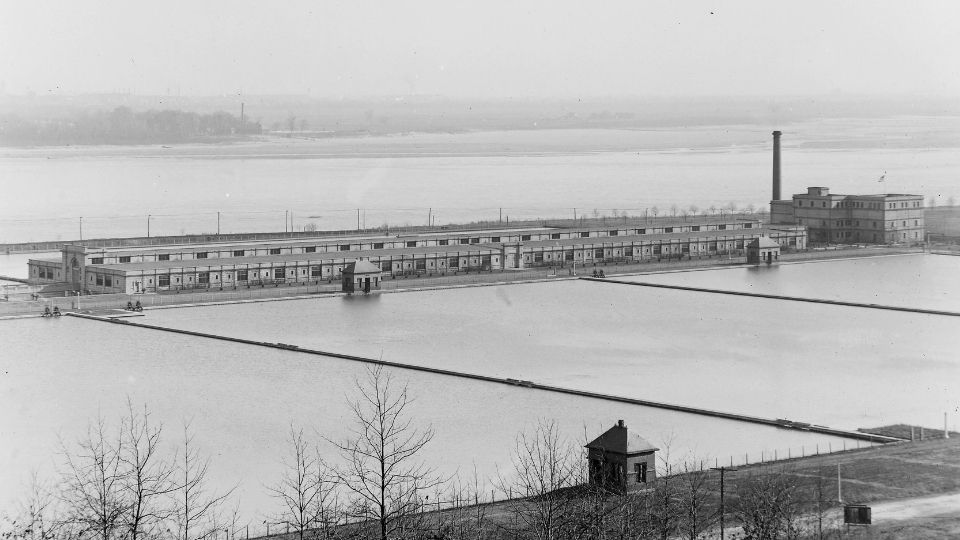
The Chain of Rocks Plant, when it went into service in 1894, consisted
of an intake structure located in the river about 1500 feet from shore.
The downtake shaft from this tower supplied a tunnel 7 feet. in diameter
which terminated in a wet well.
The low service steam pumps of the crank and flywheel type boosted the
water to a delivery well, and thence to the filling conduit which fed the
water to six enormous sedimentation basins. These basins were arranged in
parallel for the "Fill and Draw" method of sedimentation, by an
arrangement of gates on the filling side and a companion gate on the drawing
side. After a period of plain sedimentation, the water was collected continuously
by a drawing conduit, which supplied water by gravity to the High Service
Station at Bissells Point, 7-1/2 miles downstream from the new works.
At this stage in the history of the St. Louis Waterworks, St. Louis had
a Low Service Station at Chain of Rocks and a High Service Station at Bissells
Point, with storage at Compton Hill. A short time later, the High Service
Station at Baden was built to serve the area west and north of the Compton
Hill Low Level System.
Because of the high turbidity of the settled water being delivered to
the Consumers, many investigations were tried to increase the removal of
suspended solids by the plain sedimentation method. Among these was the
design of the filling chamber in the shape of a section of a cycloid.
This was supposed to be the path taken by a falling particle under the
influence of gravity in the shortest possible time. Another gadget was the
skimming weir, with the water flowing in a thin sheet from one basin to
the next. All of these schemes failed to clarify the water any better than
the "fill and draw" method.
At the turn of the century, St. Louis, the largest City in the Mississippi
Valley was making plans to celebrate the purchase of the Louisiana Territory
by Thomas Jefferson in 1803, by an exposition known popularly as the "World's
Fair." Mayor Rolla Wells had promised the Fair Committee that St. Louis
would have clear water for the Fair.
Experiments in the use of Lime and Ferrous Sulfate had been made at Quincy,
Illinois, using Ferrous Sulfate, a by-product of the pickling of steel with
sulfuric acid at the plant of the American Steel and Wire Company.
Heeding the order of Mayor Wells, Ben C. Adkins, Water Commissioner,
and Edward E. Wall, principal Assistant, investigated the process at Quincy.
The Quincy Process consisted of the use of saturated lime water produced
and settled by slaking quicklime in a large tank. The supernatent was then
added to the water under purification together with the ferrous sulfate.
This was obviously unsuitable for a large supply such as St. Louis and
Mr. Wall, in a paper subsequently published, said, "At Quincy, Illinois,
and other places, the lime was reduced to a solution and added in constant
quantity of known strength. To undertake to add the requisite quantity of
lime water to the raw water used at St. Louis, meant a reduction from thirty
to forty tons of lime daily, which would necessitate a maximum capacity
of about ten million gallons of lime water. To manufacture such a quantity
of lime water every 24 hours would require an equipment of machinery and
storage so large as to make the idea utterly impracticable."
Accordingly, the department hired John F. Wixford , a Chemist and Assayer,
to investigate, and if possible, improve the process to manageable proportions.
After numerous experiments, Wixford found that the use of milk of lime,
slaked at a temperature of 190 degrees F. gave consistently good results.
He patented his process in the United States and Great Britain.
Wixford did some of his work at the old May St. Extension Office and
some of it in his own lab on North Ninth Street. At one place in his investigation,
he was assisted by Charles H. Holman, the young son of former Water Commissioner
Minar L. Holman, who worked with him setting up the experiments. It is because
of Wixford's work that World's Fair visitors and St. Louisans alike were
delighted by the sparkling clarity of the waterfall at the Cascades, a focal
point in the Fair plan.
John Frederick Wixford was born in St. Louis, graduated from Washington
University in 1886, majoring in Chemistry. He maintained a laboratory and
assay office in his home, a three story brick building which formerly stood
at 2223 N. 9th Street. He was a lifelong bachelor, who used the first floor
for his laboratory, the third for his living quarters and the second as
a flop-house for the neighborhood derelicts.
He was a brilliant eccentric who worked in the manner of Thomas Edison,
in that he had no regular hours when working on a problem. He would pursue
it until he became tired; sleep on a cot in the laboratory, then rise and
go at it again.
During such sessions, there were no regular meals or personal grooming.
His clothes and appearance were as disreputable as the people who were quartered
on the second floor. He performed his own dental work with copper wire.
When the occasion demanded it, however, he dressed in his best to transform
into a distinguished gentleman. I can recall when he and I took the examination
given by the old Efficiency Board when he returned to the Water Division
in 1927, he appeared in a clean, ancient suit, derby hat, wing collar and
ascot tie, carrying a gold-headed cane.
Edward E. Wall, Asst. Water Commissioner from 1903 to 1911, and Water
Commissioner from 1911 to 1925 and Director of Public Utilities from 1933
to 1940, was an engineer and administrator of great ability, who guided
the St. Louis Water Works through the period of its greatest expansion.
He was a graduate in Civil Engineering from the University of Missouri in
1884.
As the people of the City of St. Louis knew Mr. Wall for his accomplishments
as Water Commissioner for so long a time, it would seem strange that they
were not equally familiar with Mr. Wixford and his contribution to the health
and welfare of the City.
As I knew both of these men, I can say in plain truth that Mr. Wall not
only ignored Wixford's work, but discredited him at every opportunity. No
less a person than Prof. Francis E. Nipher of Washington University said
in a statement written in behalf
of Wixford, "In Mr. Wall's paper in the Transactions of the American
Society of Civil Engineers, November 6, 1907, for which he (Mr. Wall) is
reported to have received a prize, Mr. Wixford's name is not mentioned as
having had anything to do with
planning the "New Process" (as Mr. Wall styles it in another paper
in Engineering News, Vol 521, No. 17). His paper is worded in language well
calculated to create the impression that Mr. Wall was the inventor of the
"New Process"." And so, even the greatest of us have feet
of clay!
Beyond setting the record straight in a controversy between two able
men, there is no point in pursuing it at this late date. It becomes a blind
spot in the character of a great engineer, who probably was secretly ashamed
of his performance.
As a result of chemical coagulation of the highly turgid Mississippi
River water, St. Louis not only enjoyed clear water, but was able to put
her best foot forward for the world to see during the Fair.
In 1908 a new coagulant house was built to contain storage for lime and
ferrous sulfate, machinery to put them into solution, and pumps and proportioning
equipment to feed the charges accurately.
In 1911, Mr. Wall was made Water Commissioner. He immediately began to
envision improvements and expansion of the Water Works to the 1930's. A
new intake was built mid-stream, and slightly upstream from the original
raw intake. He also promoted the conception of a filter plant as a final step in the purification
of the Water which comprised Primary and Secondary Coagulation, followed
by filtration and chlorination.
Edward E. Wall was a man of vision and stature. Born in Cambridge, Missouri,
on August 15, 1860, he was educated in public schools and the University
of Missouri where he graduated in 1884 with a degree in Civil Engineering.
During his long career, he was employed on railroad surveys and construction;
surveys of the Mississippi and Missouri Rivers 1884-1889; engaged in engineering
and contracting 1890-1892; Asst. Engineer St. Louis Water Works and Sewer
Dept. 1893-1903; and as principal Asst. Engineer and Asst. Water Commissioner
1903-1911. His concept for the Filter Plant at Chain of Rocks was imaginative,
and he was able to attract and hold some of the most skilled engineers to
work on the project.
At the time of its dedication in 1915, this plant was the largest filter
plant in the world. With 40 filters stretching along an aisle 700 feet long,
it was, and still is, impressive. Designed for 4 mgd per filter, it has
a capacity of 160 million gallons daily. The filters, with a media of sand
and gravel, are of the ridge-block and strainer plate construction. The
controls, until a recent installation for air operation, were hydraulically
operated. It is the opinion of some, myself included, that the ridge-block
and strainer plate construction of a filter underdrain, has advantages over
most current underdrain systems, from the standpoint of reliability and
uniformity of washing. It is a matter of some pride to the present Water
Division management that these filters perform as perfectly today as the
day they were built 53 years ago. This, I think, is a testimony to good
maintenance and intelligent operation.
By the summer of 1912, Mr. Wall, as part of his plans to keep St. Louis
ahead in the matter of plentiful supply of pure water, had survey parties
on the Missouri River at a place called Howard Bend. He thought it well
for St. Louis to have a second string to her bow in the way of an "independent
and separately operated water plant." The location was west, to serve
the population which had begun to press upon the corporate limits of the
City.
By 1923, the plans for the new works at Howard Bend were far enough along
so that a cost estimate of $11,000,000 could be included in a Bond issue
election for general City improvements. This passed handily, and St. Louis
was again on the move in its effort to change its image.
The original plant, which went into service in October of 1929, consisted
of two presedimentation basins, two primary coagulation basins, secondary
coagulation and sedimentary basins, carbonation and filtration. The presedimentation
and primary coagulation basins were equipped with Dorr Clarifiers for continuous sludge
removal. Later, in 1931, the capacity was increased to include four additional
small and one large basin.
All of us fallible human beings are inclined to view past events with
a vision that is somewhat distorted in its perspective. The water works
man looks at the design and construction of the early plants in his department,
and imagines that the span from conception to construction and beyond, was
unmarred by mishap or failure. Everything worked exactly as planned. The
author arrived at Howard Bend in 1931, almost 2 years after startup. A host
of things were still not working. John D. Fleming, the first Chemical Engineer
in charge of Howard Bend said in one of the Annual Reports, "The Otis
Elevator at the Coagulant House has not been at all niggardly in its contribution
to the general fund of Coagulant House troubles." Mr. Fleming was never
one to pull punches. Eventually all systems were "go", and with
one or two exceptions which still plague operation, the plant functions
in a satisfactory manner.
The St. Louis Water Works has always tried to be in the vanguard of new
developments, seeking to devise and explore new methods for better operation,
treatment and quality.
For years, until the main stem and tributary dams built on the Missouri
by the Corps of Engineers changed the raw water quality, both plants coped
with extremes in turbidity and color. Turbidities ranging up to 18,000 JCU
were common, and the average was 2500 JCU. Today the average turbidity is
around 500 JCU. We were, of necessity, engaged with exploration of methods
by which better coagulation could be effected to bring the influent to the
filters to a reasonable level. One illustration is the pioneer work of August
V. Graf, Chief Chemical Engineer, who, with the author, discovered and developed
the use of activated silica as an aid to coagulation. This work was begun
in 1934 and culminated in a patent in 1941 to W.B. Schworm and A.V. Graf.
Mr. Graf, who graduated from Washington University in the first class on
the present campus, was employed by the Water Department in 1911, the year
Mr. Wall became Water Commissioner. Whether there is any connection between
these two events, I cannot say. He remained in charge of purification until
his retirement in 1960 at the age of 80.
As part of the 1923 expansion of the Howard Bend System, the City built
a reservoir on Stratman Hill on the Olive Street Road, at a point where
the St. Louis County Water Co., had a reservoir for 25 years. The City structure
was named Stacey Park, and has a capacity of 100 million gallons. It serves
the high level system, generally in the west and south portions of the City.
With the exception of primary and secondary mixing and conditioning basins
which were constructed in 1954-1955, the Howard Bend Station has had very
few changes in recent years. Some errors in engineering judgment have been
corrected which have produced a water plant which is as satisfying to operate
as it is to look at.
In the career of every man, one event and one person will stand out and
be remembered. The event will usually be one that taxes ingenuity and stamina,
and the person is usually the man who prevented the event from becoming
a catastrophe. The man I have in mind at that time in my career is John
B. Dean, the event is the flood of 1951. Mr. Dean, Division Engineer of
the Supply and Purifying Section until his death in 1960 was a man of foresight.
As a young engineer out of college, his early experience with rivers and
their moods was gained as an assistant engineer on the Corps of Engineer
boats.
Several years before the flood of 1951, Mr. Dean had formulated a plan
to protect the water plants from disaster. At the time this included Chain
of Rocks, Howard Bend, and Bissells Point. His plan was so comprehensive
and detailed in every respect that the person in charge of each plant could
read what he could expect at every elevation, and prepare for it. The result
was order instead of chaos, faith instead of apprehension.
In the late 1950's, Mr. Conway D. Driscoe, Director of Public Utilities,
and others, decided to electrify the Chain of Rocks Station. This decision
had far reaching implications. It called for abandonment of steam as the
prime mover for low service pumping. It envisioned the construction of large
transmission lines to the high and low distribution levels, which ultimately
made the Bissells Point and Baden Steam Station obsolete.
A new electric distributive pumping station at Chain of Rocks took over
the functions of these earlier steam plants. The steam plants have since
been demolished.
No stone remains to delight the eye, and the sound of the steam escaping
from the poppet valves of the big E.P. Allis triple expansion engines remains
only in the mind.
All that remains of the original pumping plant at the Chain of Rocks
Station is the pump pit, which has had its face lifted by a new modern exterior
facade.
As part of the plan, a new clear basin of 10 MG capacity was built to
cushion the suction of the High Service pumps. The design of the wall structure,
conceived by E.E. Easterday, Engineer in Charge of Design and Construction,
was unique and original. It consists of phalanx of contiguous truncated
cones, which allow the hollow interiors to function as a dry well.
Later, in 1960, the old Brick Coagulant House, built in 1908, was replaced
by a new one at a higher elevation, where the chemical lines to the primary
and secondary coagulation stages could be shortened considerably.
As the last building to be abandoned under the most recent expansion,
the Coagulant House at Chain of Rocks is deserving of special mention. It
lasted for 52 years and could, with installation of more modern machinery,
have lasted another 50. Its old direct current motors and pendulum clock-operated
timing devices were still going strong when the AC-DC motor generator which
supplied the current was shut down for the last time.
As the buildings, the machinery, and particularly the men who made the
St. Louis Water division what it is, fade into the limbo of the past, we
can remember the things as they were. But we as Water Works men cannot live
in the past or in the present. It is we who live 20 to 30 years in the future.
It has been always thus, except that now the pace is faster.